Proprietary / MICROBIAL NUTRITION
NitroPro®
Microbial nitrogen nutrition
A proprietary microbial product designed to support nitrogen nutrition through beneficial root-zone bacteria.
Product use requires market-specific review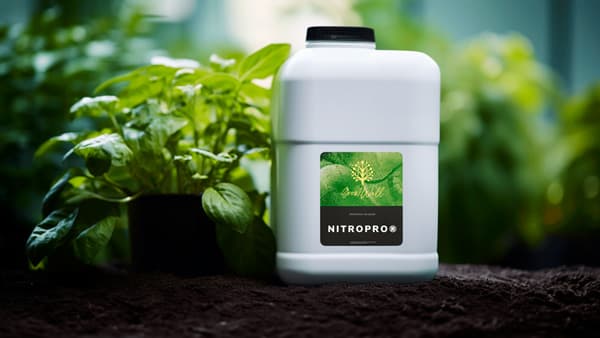
Original product artwork; packaging text is preserved.
FORMULATION IDENTITY
Know the product you are comparing.
The source catalogue identifies living Beijerinckia fluminensis cells. Biological nitrogen fixation converts atmospheric nitrogen into reduced nitrogen forms; subsequent soil processes influence the forms available to roots. The contribution depends on the formulation and growing conditions.
- Organism
- Beijerinckia fluminensis
- Website specification
- ≥ 100,000 CFU/mL
CFU means colony-forming units. One cm³ equals one mL; the original catalogue specification is retained in the source.
Biological nitrogen fixation
Nutrient uptake in context
This diagram explains the intended role. It is not a measured nutrient balance or a guarantee of crop response.
Intended stages and programme planning
- Review the early crop nutrition programme
- Confirm a locally appropriate application protocol
- Measure performance against the existing programme
Conditions and documentation
- Root-zone moisture and temperature affect biological activity.
- Crop stage, soil properties and the existing fertilizer programme affect the context.
- Confirm the exact formulation, destination-market label and tank-mix guidance before application.
EVIDENCE FOR THIS FORMULATION
Read the result with its context.
Trials for Azotovit do not automatically establish the performance of NitroPro. Request evidence for this exact formulation and intended growing context.
Inspect the field evidenceBefore you use this product
Can a result for one product be used for another?
A shared organism or similar purpose does not establish equivalent formulation or performance. Match the exact product, crop, dose, application and background management to the evidence.
Will I obtain the percentage shown in a trial?
A reported comparison is an observation in a specific setting. Use the quick calculator to explore an explicit assumption, then validate the programme locally with a suitable control.
Can I mix a product with pesticides or micronutrients?
Compatibility depends on the exact formulations, concentrations, water and application method. The public FAQ excludes antibacterial agents, but broad compatibility statements do not replace product-specific guidance.
What storage conditions should I follow?
The public FAQ lists +3°C to +30°C, while the supplied test protocol lists 0°C to +30°C. This conflict must be resolved against the current label. Avoid freezing and direct sunlight; obtain batch-specific guidance before shipment.