Proprietary / MICROBIAL NUTRITION
PhosActive+®
Phosphorus and potassium mobilization
A proprietary microbial product positioned to help plants access phosphorus and potassium already present in the root environment.
Product use requires market-specific review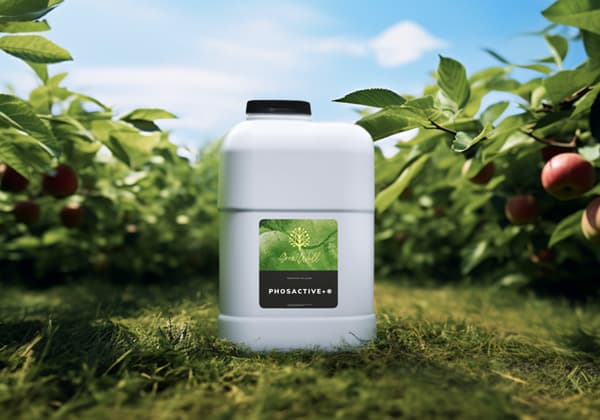
Original product artwork; packaging text is preserved.
FORMULATION IDENTITY
Know the product you are comparing.
The source catalogue identifies spores and living cells of Paenibacillus mucilaginosus. Its stated mechanism involves organic-acid production and nutrient mobilization in the rhizosphere. Mobilization does not create phosphorus or potassium and does not establish complete uptake or universal fertilizer replacement.
- Organism
- Paenibacillus mucilaginosus
- Website specification
- ≥ 120,000 CFU/mL
CFU means colony-forming units. One cm³ equals one mL; the original catalogue specification is retained in the source.
Root-zone mobilization
Plant access to available nutrients
This diagram explains the intended role. It is not a measured nutrient balance or a guarantee of crop response.
Intended stages and programme planning
- Assess existing soil nutrient availability
- Review the crop and root-zone environment
- Compare the complete nutrient-management programme
Conditions and documentation
- Root-zone moisture and temperature affect biological activity.
- Crop stage, soil properties and the existing fertilizer programme affect the context.
- Confirm the exact formulation, destination-market label and tank-mix guidance before application.
EVIDENCE FOR THIS FORMULATION
Read the result with its context.
Evidence for Phosphatovit must not be transferred automatically to PhosActive+. The shared organism name does not establish identical formulation or local performance.
Inspect the field evidenceBefore you use this product
Can a result for one product be used for another?
A shared organism or similar purpose does not establish equivalent formulation or performance. Match the exact product, crop, dose, application and background management to the evidence.
Will I obtain the percentage shown in a trial?
A reported comparison is an observation in a specific setting. Use the quick calculator to explore an explicit assumption, then validate the programme locally with a suitable control.
Can I mix a product with pesticides or micronutrients?
Compatibility depends on the exact formulations, concentrations, water and application method. The public FAQ excludes antibacterial agents, but broad compatibility statements do not replace product-specific guidance.
What storage conditions should I follow?
The public FAQ lists +3°C to +30°C, while the supplied test protocol lists 0°C to +30°C. This conflict must be resolved against the current label. Avoid freezing and direct sunlight; obtain batch-specific guidance before shipment.